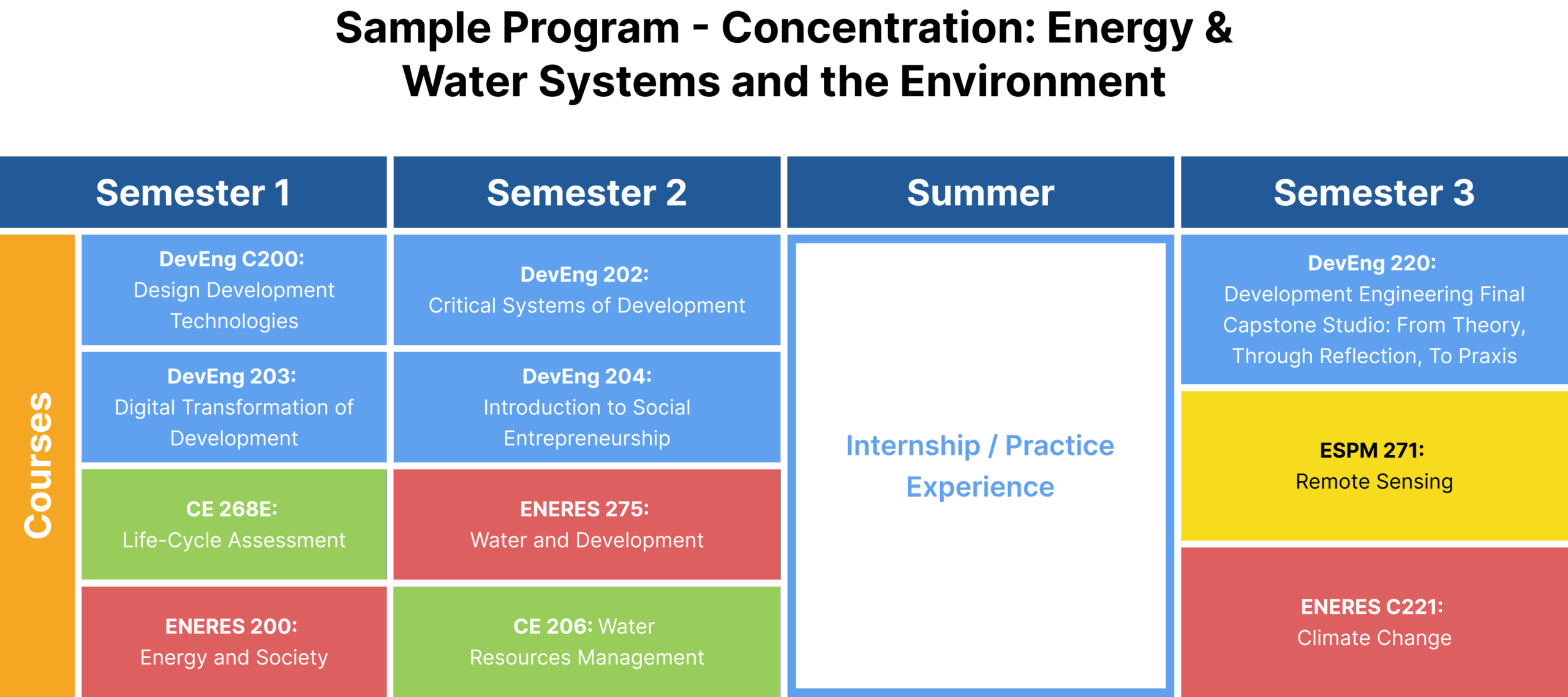
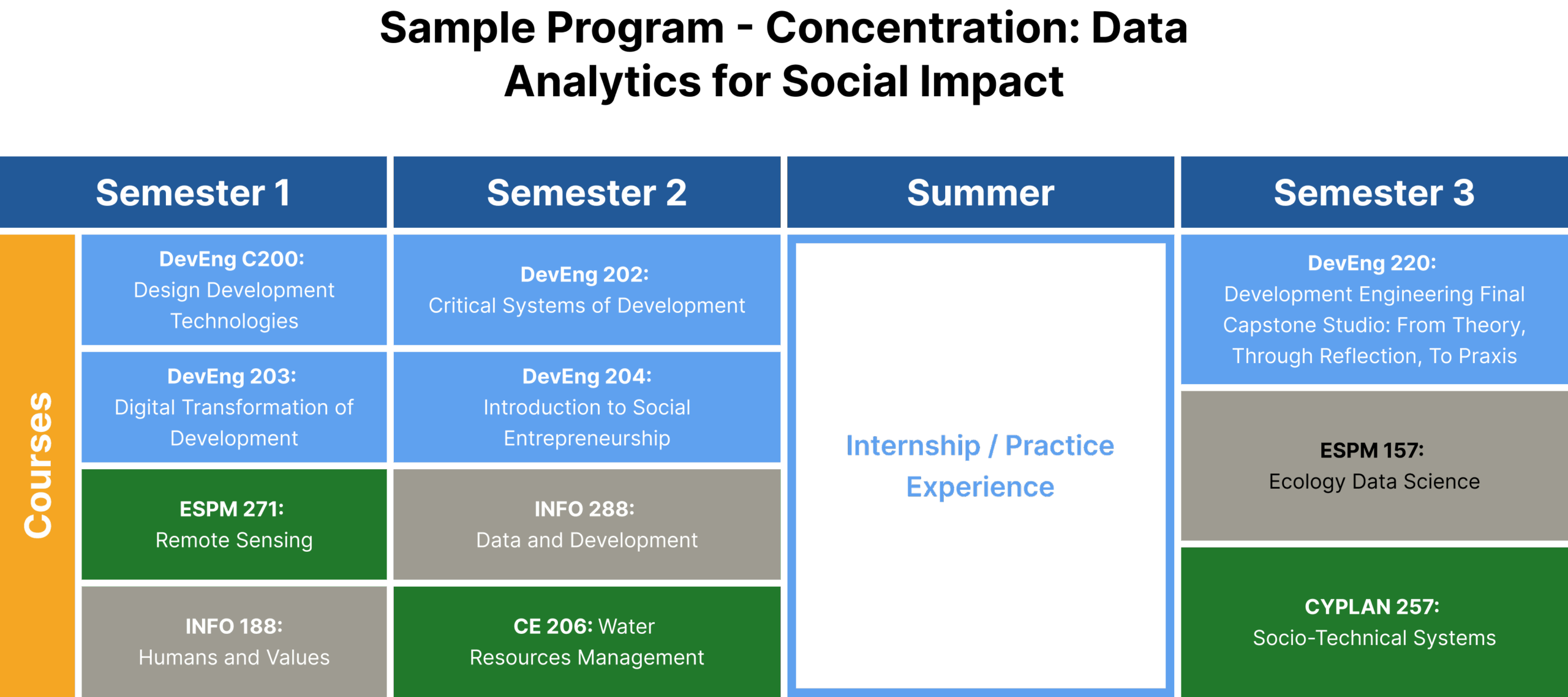
Required Courses
DevEng C200: Design Evaluate & Scale Development Technologies: The course provides project-based learning experience in the development of human-centered products, services, or systems. The course teaches the mindsets, skill sets, and toolsets of design thinking with a focus on its use in development. The course is focused around the following modules that cover core phases of the design process: observe and notice, frame and reframe, imagine and design, and make and experiment. Students will also learn the theory of change and methods for assessing potential impact of technology interventions. Students will be expected to learn ethnographic interviewing, webs of abstraction, ideation, and basics of both hardware and software prototyping. The course will engage social impact designers from industry as speakers and coaches.
DevEng 203: Digital Transformation of Development: As technology use proliferates globally, there exists significant potential leverage to further understand and improve the lives and livelihoods of people in low-resource settings. Through a careful reading of recent research and through hands-on analysis of large-scale datasets, this course introduces students to the opportunities and challenges for data-intensive approaches to development. Students should be prepared to dissect, discuss, and replicate academic publications from several fields, including development economics, machine learning, information science, and computational social science. Students also will conduct original statistical and computational analysis of real-world data. They will gain an introduction to sensors as well as tools and methods for spatial modeling and spatial data analysis.
Two electives are required in addition to the above courses.
DevEng 202: Critical Systems of Development: This course is intended to provide students in the Master of Development Engineering with the necessary background and knowledge to undertake projects and work experience of a global scope. Students will be exposed to a diversity of methodological frameworks, introduced to the skills needed to effectively participate in the sustainable development field (such as systems mapping and landscape analysis), and to understand the history and ethics of global development. Students will be required to complete an annotated bibliography and a systems analysis of a problem of interest.
DevEng 204: Introduction to Social Entrepreneurship: Social entrepreneurship entails market-oriented approaches to address social problems for sustainable, scalable outcomes. This course will enable students to frame complex problems and devise entrepreneurial approaches for addressing them. Students study the dynamics of societal challenges and the conceptual framework of social innovation and social entrepreneurship from theoretical and practical perspectives. Students also explore technology solutions to address global social problems with a systems thinking approach. Students additionally learn how to develop appropriate business models and implementation strategies for a social venture. Student projects will integrate the development engineering goals of creating technology interventions designed to improve human and economic development in complex low-resource settings. This course is the first of a sequence of two final project courses for candidates of the Master of Development Engineering.
Two electives are required in addition to the above courses.
DevEng 220: Development Engineering Final Capstone Studio: From Theory, Through Reflection, To Praxis (6 units)
The course combines three core components: the hands-on work of developing and refining a technological intervention for low-resource settings or the development of research that can act as an intervention for structural change and social justice; critical reflection on the role and ethics of development engineering in a complex world; and engagement with current practitioners to understand diverse perspectives in the field.
Two electives are required in addition to the above courses.