Amir Kelifa witnessed societal inequality in his home country of Ethiopia. He saw how workers in the informal sector, like waste collectors, faced exploitation, unsafe working conditions, and low pay.
Kelifa wants to change that.
He is among two dozen students who have just arrived at UC Berkeley for the Master of Development Engineering program planning to solve critical problems they see in the world.
“It’s very sad,” he said of the disparity between what waste collectors earn and the industries that benefit from the waste.
“Those who receive that waste and process it, exploit child and woman labor — they upcycle that waste and get more value out of it,” he said.
Kelifa wants to know more about these issues to figure out how to better integrate informal workers into the economy to provide people with “dignified work opportunities.”
“When I found Development Engineering and when I learned it combines all those things — engineering, economics, entrepreneurship and policy — to actually address such kinds of problems,” Kelifa said, “I was like yeah, this is my program.”
He has also seen the challenges entrepreneurs face in Ethiopia, especially youth and women who are often sidelined from starting businesses, he said.
“If you want to get your ideas off the ground and scale them, financing is a challenge,” he said. “There are no formal, well-established financing structures in place that can support you.”
To address this issue, he pointed to the need for financial technology in addition to an understanding of politics, social norms, and cultural nuances to create lasting solutions.
Kelifa is excited to learn from a diverse cohort and to be around the MDevEng program’s entrepreneurial culture.
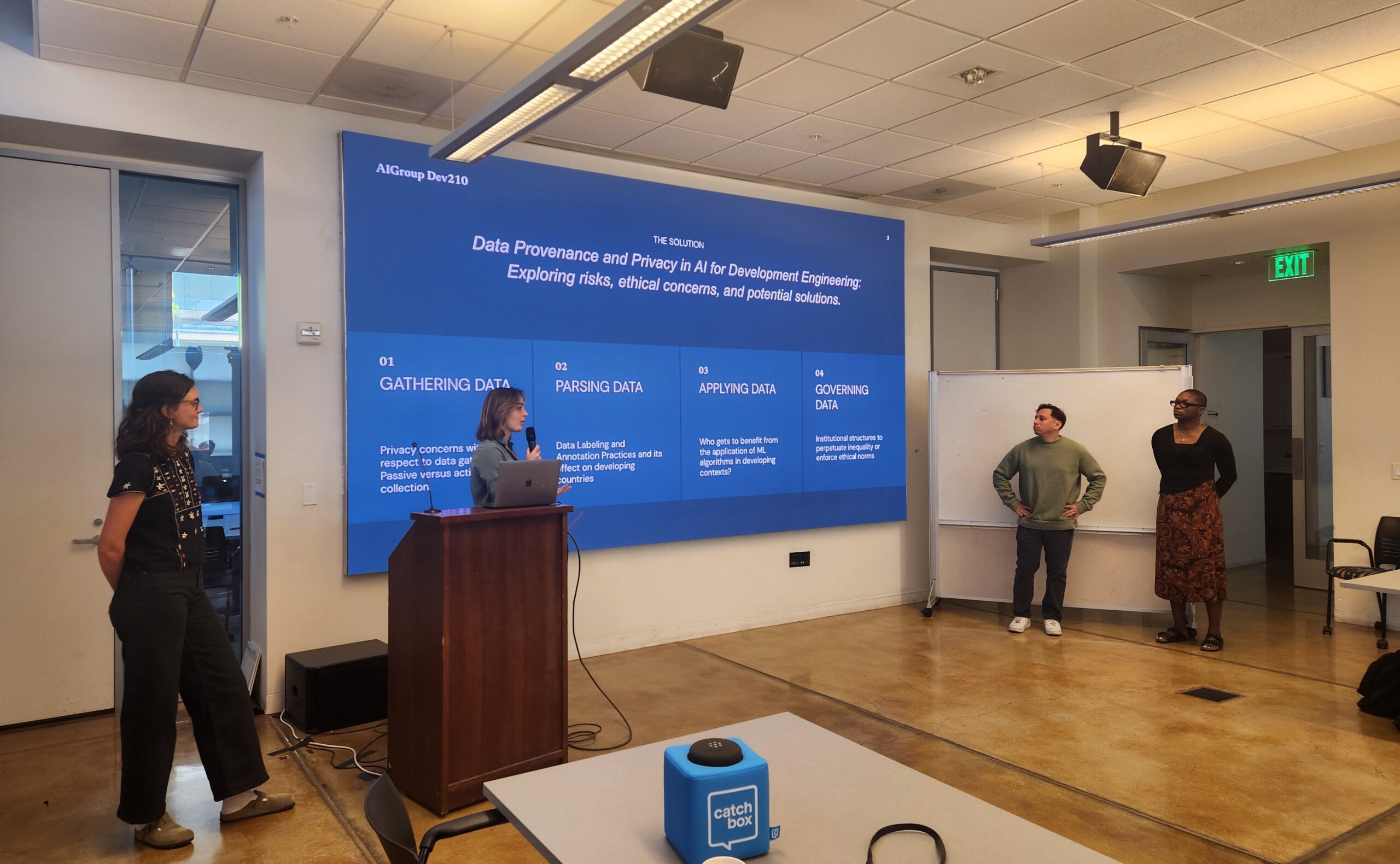
The three-semester MDevEng program integrates engineering with entrepreneurship, design, public policy, and the social sciences to help students develop technological solutions in low-resourced communities.
Students in the Class of 2027 cohort came to Berkeley from countries all over the world, including the U.S., China, Bangladesh, Nepal, Rwanda, and beyond. They also have diverse professional backgrounds. While some have experience in mathematics, data science, and engineering, others have backgrounds in urban planning, economics, and even creative writing.
“The world is filled with many problems, and that means there’s lots of work for us to do together to find solutions to those big problems,” Daniel Fletcher, faculty director of the Blum Center, told them on their first day on campus. “It requires the backgrounds that you all have, the range of different backgrounds, and being able to communicate across those boundaries so that we can find solutions.”
Kara Nelson, chair of the Graduate Group in Development Engineering, reiterated the importance of working together to solve challenging issues. She pointed to the program’s emphasis on project-based learning and team work.

“The big problems that we face in the world cannot be solved by individual disciplines,” Nelson told students. “They are all interrelated to other sectors, and learning how to work in interdisciplinary teams is one of the things we focus on a lot in DevEng.”
Tanesha Aden, from Jakarta, Indonesia, has a background in urban planning and a former job working for the Indonesia government.
She wants to find solutions to problems that have been challenging to solve.
“Because Indonesia is still a developing country… by learning a lot of things in Development Engineering I can find more solutions to areas in Indonesia that are still underdeveloped,” she said.
One issue is the accessibility of public transportation. Aden saw this issue firsthand when she was pregnant and needed to take the bus from her home to work.
“I saw that some stations didn’t have elevators. I could still walk up stairs, but how about people with disabilities?” she asked.
Her classmate, Ben Fields, an industrial engineer, found the program after working with Engineers Without Borders, an organization that unites volunteer engineers and underserved communities to develop infrastructure solutions.

After working for a time in a corporate setting as an engineer, Fields realized he didn’t feel like he was helping anyone.
He wanted to do similar work to Engineers Without Borders. This led him to the MDevEng program.
“This graduate group seems more focused on how can we support the sphere of the world and everyone,” Fields said. “Not just our specific area, but using our area and our resources and our smarts and abilities to build up everyone.”
He looks forward to working on the connection between engineering, policy, and implementation, especially on issues with water and energy access.
The latter was a critical issue for a rural community in west North Carolina he worked with while an undergraduate at Clemson University.
He saw how hurricanes were hitting the town year after year. The community was located far from the coast, blocked by the Appalachian Mountains. Living at the end of the supply chain made getting access to resources to rebuild after the destruction a challenge, Fields said.
“If all the power lines go down and there are road blockages for 200 miles east of you, and there’s no way to access your town from the west,” he said, “you have to wait for all 200 of those miles to be repaired before it can actually do anything for you.”